

Summer 2012: The campaigns for President kicked into high gear with the two-party national conventions. Mitt Romney, my wife’s Mormon cousin on the polygamy side of her family, was the Republican nominee. Yikes! Kolob, here we come. My wife’s sister and her husband were busy with their newspaper jobs covering the national parties’ conventions, and stuck in sweaty backrooms from where they sent teams of reporters down to the convention floor for updates on the latest news or speech. They both gained about five pounds and lost lots of sleep during their stay.
October 2012: We survived our annual Christmas photo shoot with our youngest nieces and nephew, and their parents, whom we adore. The kids brought their Halloween costumes too for photos in their outfits for posterity, I assumed. I am not quite sure what the girls were supposed to be. Some types of monster princesses, I was told. Their brother was a garden gnome on top of a mushroom. Not your run-of-the-mill stuff. Their mother let them pick out their outfits via an online costume rental place, and that was the result. After the shoot, we were treated to dinner at a local Mexican restaurant. Monster princesses, and garden gnome in tact.
Weather news: “Sandy,” the monster storm dubbed Frankenstorm, hit the Eastern Seaboard last night with high winds, flooding, and power outages affecting over 11 million people. NYC seems to have been the hardest hit. My wife’s sister and her hubby’s home was okay with just a few branches down and the loss of one small tree. During the storm’s worst, her sister was forced to stay at a hotel near her USA Today office building. She told us her office building lost the letter “A” from its sign in the storm, adding it came right by her window on its way down. No doubt it waved to her and gave her a short interview as it plunged to the sidewalk, killing four newsboys. (Okay, I made that killing part up, in case you’re worried).
Election & God-Related News: One of our twin nieces, both who are in the final days of their church’s mission to push The Book of Mormon onto unsuspecting Latino families in Central America, where they offer converts eternal salvation (who doesn’t?), their own world, and “When you die, you’ll get a new, perfect body and be able to eat all the Mexican food you can stomach without gaining an ounce,” had contracted Dengue Fever. She was put on bed rest until further notice. They were both due home a few days before Thanksgiving. Given that, we were invited over for the first time in six years to pay homage to the girls and the great OZ, AKA Mormonism. However, complicating matters was that if Romney won the Presidency, it’s sticks up the butt piety for everyone during the next four years, beginning at Thanksgiving dinner. LDS members will be handing them out like party favors from their personal collections, which include their everyday church sticks up the butt, and the dinner with pagan relatives sticks up the butt. For our sake, we can only hope *Romney loses.
November: Our Thanksgiving dinner’s emphasis, besides the turkey, was to celebrate the girls return from their eighteen-month mission. The dinner crowd was stacked heavily in favor of the Mormons no doubt to counter any satanic influences unintentionally oozing out from us. During dinner, we dutifully engaged in polite, happy talk with our fellow dinner guests, whose faces glowed with toothy, eternal smiles. After dinner, we were given the bum’s rush with a swift table clearing and doing of the dishes in record time. A tradition of our hosts was to go to a movie right after dinner. So, off you go shortly after 4:00 PM, and we were ushered out the door. No football on TV, no small talk, times a-wastin’.
*Author’s note: Mitt Romney did lose the election and retired to Northern Mexico, passing his time waiting for God by selling driftwood and corn dogs to tourists.
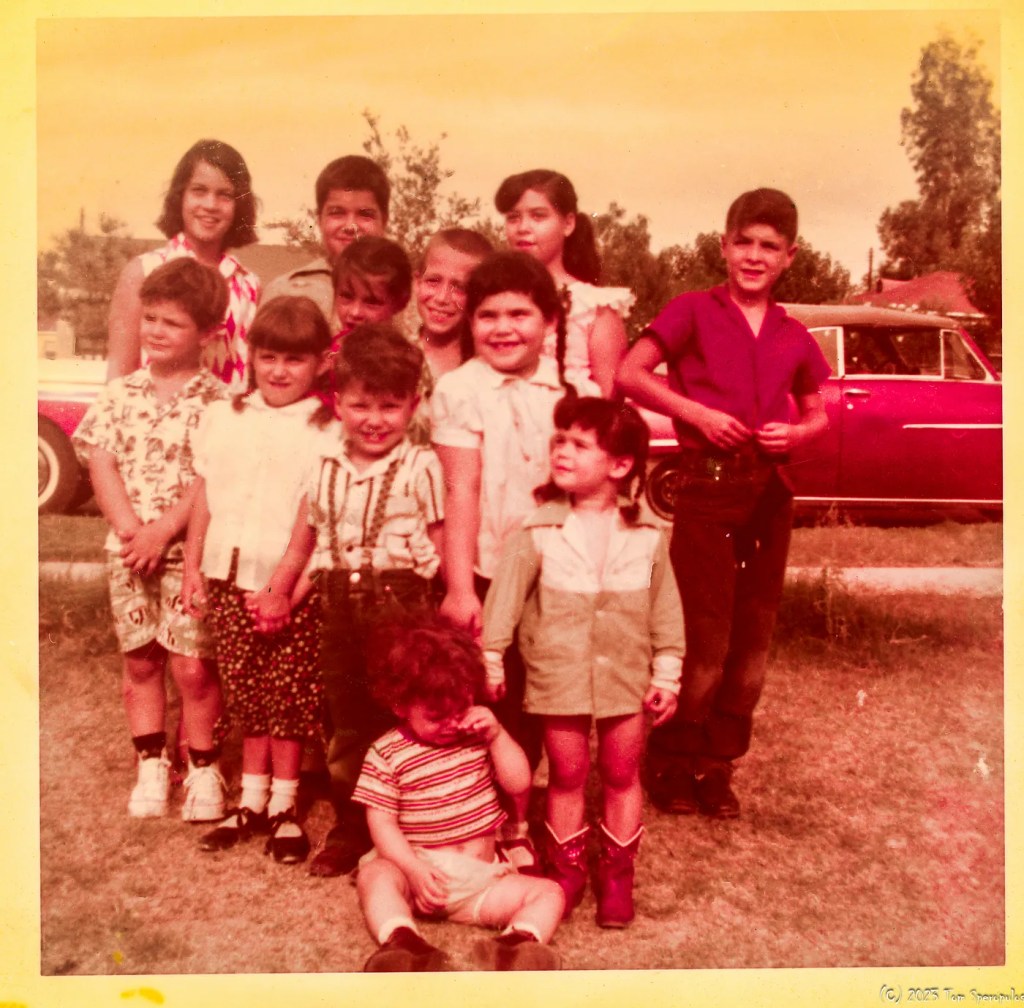
First Cousins
A Family Chronicle
The death of loved ones is inevitable, but it always catches us by surprise. My first cousins and my sister are the remaining vestiges of my blood family. My parents, grandparents, aunts, and uncles are all long gone; stardust floating about the ether.
I had fifteen first cousins. I say had because nine of the fifteen are no longer on the planet. I never had a relationship with any of them growing up, as many do, where cousins become an extension of your immediate family. We were told by my mother, who disliked their parents, that they were bad people. There was a little more detail to it than that, but that was essentially it. I rarely, if ever, saw any of them growing up, and even that was at a metaphorical arm’s length. The family ties that would have made me closer to them weren’t there.
Whenever I learned of any of their passing, it was like being told a total stranger had died. Only as an adult did I briefly have contact with any of them, but not enough to feel the need to attend their funerals; I was not attending out of hate or bad feelings, but rather complete dispassionate indifference from not knowing them or ever being a part of their lives. That and traveling fifty miles in formal wear to sit uncomfortably on hardwood benches in an incense cloud of smoke for two hours while a Greek Orthodox priest, speaking Greek, recited a well-practiced liturgy detailing how the deceased will suffer in Purgatory for forty days, before going to Heaven; burning flesh, worms eating their eyeballs, and other fun things. To equivocate, some, I will say, of course, it is always unfortunate when someone has died, but we all will die. How and when are the unanswered questions we carry around with us until the end. It seems everyone wants to go to Heaven, but no one wants to die.
How they died is often asked when someone leaves the planet to become stardust. In my cousins’ case, their passing was either self-inflicted or happenstance. For example, my cousin Burleigh, a jockey, met his demise while training a young horse that bucked violently, and he was thrown off and slammed headfirst onto the track. The impact severed his spinal column, and he died instantly. His mother, my Aunt Connie, indirectly contributed to his death. She was an obsessive gambler and pressured him as a young boy to become a jockey so he could feed her information on which horses to place her bet on. In her defense, she suffered from a childhood trauma when her father (my Grandfather) shot and killed one of her sisters for arguing with him when they were teenagers. She ended up more than a little bit off kilter after that, and was forced by her family to go through multiple electroshock therapy treatments during the 1950s, before it became a more refined procedure, to snap her back into shape. The therapy did little more than fry her brain and give her frizzy hair.
Years later, Burleigh’s three sisters died in quick succession, all within a year of each other. Two of their three deaths were self-inflicted denials of reality and modern medicine.
The three Teretsky sisters: Andreana, named after her dad’s mother, was the first to go. She and her sister, Georgia, named after Grandma Speropulos, were dedicated wackadoodle Christian “Holly Rollers,” and disavowed all vaccines and conventional medicine for Naturopathic Medicine. So much so that when Andrianna contracted the COVID virus, she proclaimed the COVID pandemic was nothing more than a Satanic hoax and denied she had COVID. Her Naturopath prescribed herbs and a diet change to treat her UTI (urinary tract infection), according to his diagnosis of her illness. When his meds didn’t work, and her health was failing, desperate, her family reluctantly took her to a hospital, where she landed in the ICU and died in short order. The family insisted her death was caused by the UTI, not COVID, and during the process, reminded us all via social media that COVID was not real and a Satanic Hoax.
Georgia followed shortly. She, too, was a firm believer in Naturopathic medicine and had a similar death of denial when her bowels bound up on her. She tried all sorts of treatments with her Naturopathic doctor for months and eventually ended up at the hospital for exploratory surgery, where the doctors discovered stage four colon cancer. It was too late, and all they could do was sew her up and send her home to get her affairs in order. She died shortly after her hospital stay.
The youngest sister, Pammie, named after no one in particular, died, through no fault of her own, from an autoimmune disease that turned her organs hard, including her lungs, until she could no longer breathe. She had the best chipper personality of the three and inherited her mother’s penchant for gambling, betting on the dog races at the Phoenix Greyhound Park. She gave me a tip that if I ever decided to try my hand at betting on dogs chasing a plastic rabbit, to place a five-spot on any dog that took a crap while it was being led to the starting gate. I thought it was an interesting take on gambling strategy.
Another cousin, a former druggie suffering from dementia, died in a rest home in the same time frame as the other deaths.
A few months later, two more cousins, both lifelong chain smokers, died from lung cancer, one day apart, after undergoing months of chemo and radiation treatments.
A fourth cousin who was a champion wrestler in high school became a druggie and ended up in the slammer serving ten years for dealing drugs. After his release from prison, he fell back into drug use and eventually became homeless. He was found in a back alley, dead inside his car from a drug overdose. The family only learned about his death after his sister found a clip in the newspaper obituaries, placed by the county, looking to locate the family for his proper burial.
I have no idea what lesson, if any, there is in this other than we’re here, and then we’re not. No one truly knows what waits for us at the end of the tunnel.
“What we have once enjoyed we can never lose. All that we love deeply becomes a part of us.” – Helen Keller.
A Photographer’s Life
While reading my monthly photography magazine, I discovered, to my complete surprise, that Susan Sontag was considered a highly regarded social observer and critic. Granted, my lack of knowledge about Ms. Sontag comes from my inability to keep up with popular culture, but regardless, I cannot help but wonder how one becomes a social observer and critic, and what it pays. It is a mystery to me how she did that. Did she attend the School of Social Observers and Critics? Or just fall into the job after a night partying with someone with connections? After all, we all criticize others. That is what humans do. “Did you see Bob last night when he wore those plaid trousers and a striped shirt? What a clown.”
Giving Ms. Sontag the benefit of the doubt and remaining open-minded, I suppose she had earned her place on the social critic’s ladder, even if she was missing a rung or two herself. Further, after reading her book *On Photography, I had no idea photography was such a complex endeavor intertwined with the universe. I realize we’re all part of some type of universal cosmos, or at least members of the Elks Club, but still, in my view, critiquing art, and espousing philosophy, along with being a social critic, is a highly subjective endeavor. I think, quite possibly, Ms. Sontag was full of bean dip. On Photography is a 1977 collection of essays by American writer Susan Sontag. The book originated from a series of essays Sontag published in The New York Review of Books between 1973 and 1977.
PS: If you love Susan Sontag and disapprove of the commentary, please send any hate email messages to: FreddiesTavern@ death valley.com
***
Day Dreaming
Daydreaming is a stream of consciousness that detaches from current external tasks when one’s attention becomes focused on a more personal and internal direction. Source: Wikipedia

Growing up, my small bedroom was my private sanctuary, where I spent hours alone, daydreaming and idling about. My hermit life was, in part, to isolate myself from the family, where yelling and conflict, typically caused by anxiety over money, or the lack of it, was the norm. My goal was not to be a bother and to keep the peace.
Adding to this was my older sister, perpetually trying to make me a better human being and more hip for the times. Hip as in the popular culture; like, how to use a Hula Hoop, the music and dances of the day; Elvis Presley, The Twist, and Chubby Checker. I wanted no part of any of that, or her efforts to make me into a cool daddy, but she was persistent (bossy). Whenever she tried this, I went into my room. My mother and sister could not understand why I escaped into my boy cave and would not come out for hours. “What’s he doing in there?” was on their minds.
I spent many happy hours playing with my army men, reading books on astronomy, and “Sgt. Rock” comics that depicted World War II battles and the victorious US Army. That, and going through the previous days’ newspapers looking for articles on the *Space Race against the Soviet Union, today’s Russia. I would clip out stories about the space race and put them in a scrapbook to admire during one of my daydreaming sessions.
In the early 1960s, the economic boom from the end of World War II was fading and transitioning into the radical 60s with its civil rights protests, Vietnam War, The Beatles, rock music, and the Cold War threat of a nuclear holocaust
Entering high school, my sister was a year ahead of me, and I prayed for her early graduation in order to be out from under her tutelage to make me a cool guy, or set me up with one of her girlfriends’ younger sisters. Luckily, it was a large school and I rarely ran into her, but the threat of seeing her hung over me constantly during my first two years. By my junior year, our school went on double sessions due to overcrowding, and she had the morning session, and I was on the afternoon session. My prayers were answered when she graduated early and was given her diploma at the close of the first semester of her senior year. I felt fully liberated.
During the last two years of high school, I did blossom into a cool guy, through no fault of my own. And, I learned everyone was struggling to be something they weren’t. I still daydream a lot, but I no longer play with army men. My sister now lives in another state and remains bossy, but is easier to take these days. Family is inescapable, and the best and the worst things we have in our lives, I think?
*After World War II drew to a close in the mid-20th century, a new conflict began. Known as the Cold War, this battle pitted the world’s two great powers - the democratic, capitalist United States and the communist Soviet Union - against each other. Beginning in the late 1950s, space became another dramatic arena for this competition, as each side sought to prove the superiority of its technology, its military firepower and–by extension–its political-economic system: Source History.com
******************
World War II brought my parents together.
Both were first-generation children of immigrants:
San Diego — 1942
My Father joined the US Navy in June of 1941 to escape his expected Old World servitude working in his father’s coffee shop. During the war, he was a flight mechanic and gunner with a squadron of US Navy *PBYs stationed in Pearl Harbor. Their assignment was to hunt and destroy enemy submarines in and around Hawaii, and as far north as the Aleutian Islands. (*PBY Catalina is a flying boat and amphibious aircraft that was one of the most widely used seaplanes of World War II.)
My Mother moved to San Diego from her idyllic Oregon home to do her part in the war effort, working in a factory as a seamstress, making parachutes. They met in San Diego before my father’s tour in Pearl Harbor began. Seeing her on a street corner with bags of groceries, he offered to carry them for her. Mother claims she’d ignored him, at first, but he was persistent. He won her over, and they were married in September of 1945, shortly after the war in the Pacific ended. My sister was born in the Navy hospital on Coronado Island in August of 1946. I followed soon after in September of 1947. My parents’ worldview was heavily influenced by the hardships they suffered during the Great Depression and the sacrifices they made during World War II. They both worked extremely hard so we, baby boomers, would have a more bountiful childhood than they did. They succeeded.
The Hat Shop — 1950 My first memories (snippets really) of life are of living in the rear of my father’s hat shop business in downtown Phoenix with my parents and sister. I remember standing on a stool, looking over the countertop, watching people come in and out of the shop. It was a cozy (tiny) place, and a former residential duplex turned commercial. I have no accurate recall of its layout, other than a partition with a swinging door between our living quarters and the shop’s front counter. It was on McKinley Street, one block east of Central Avenue, and a short walk to the famous *Westward Ho Hotel, the tallest building in the state at that time. Next door to the shop was the Savoy Restaurant. The 1950 population in Phoenix was in the neighborhood of 100,000 residents, not counting coyotes or feral cats. The Westward Ho Hotel held the title of the tallest building in Arizona for over 30 years until the completion of the Meridian Bank Tower in 1960.
The Hat Shop had an all-glass exterior covering the storefront and was emblazoned with large gold lettering shouting: Pete’s Hatter and Cleaners, Hats Cleaned and Blocked the Factory Way. The business in the other half of the duplex was a “massage parlor,” which was being closely watched by the police who, somehow, unknown to me, had placed a two-way mirror in one of our closets between our shop and the parlor. We regularly had an officer on voyeur duty keeping us company. The police eventually shut down the business and arrested the masseuse for prostitution. On the Godlier side of our street was a large Baptist church with tall columns and elevated steps fronting the building. My sister and I often played on the lawn in front of the church. In those times, children were treated like free-range cattle and allowed to meander off without fear of harm befalling them. One day, we wandered inside the church (the doors were always unlocked) and ran into a congenial African American man, who was their custodian. He was quite kind towards us and offered to show us around the church. He explained the purpose of the different rooms, and he ended our tour in the kitchen, where he offered us graham crackers and cartons of chocolate milk. We were delighted and thanked him. We told Father about our visit and asked him why the man was black and not white like us. He replied, “When God was making people, he’d accidentally left the black people in the oven too long, and they got burnt.”
God Bowling? One summer night, we were standing behind the shop’s front window, watching a brutal summer monsoon storm roll in with a deluge of rain, accompanied by scary thundering and lightning. As the storm intensified, we became frightened, and I asked my father if we were safe. He assured us, “There is no need to be scared, it’s only God, practicing his bowling in Heaven, and the lightning is from when he makes a strike.” God made a lot of strikes that night.
Santa Claus: At Christmas, like all good parents, ours fed us the Santa Claus myth as fact. And, we willingly became true believers, at least until our mother took us for a stroll in downtown Phoenix to look at Christmas lights. Walking about that evening, we saw Santas on every corner, ringing bells, and standing beside red buckets. Seeing these multiple Santas, I asked, “If there were a Santa, how come there are so many?” Mother mumbled something under her breath and then replied, “Oh, those are just his helpers.” I was only three, but I began to wonder about things: God bowling, God burning Black people, and Santa’s look-alike helpers. That same year, on Christmas Eve, I was woken by a loud pounding coming from the front of the shop. I crept in and saw my dad putting together a train set on a sheet of plywood. I knew then that the train set I asked Santa for was coming from Santa dad. I quietly went back to bed, wondering, “If God needed my dad’s help with his bowling?”
Our weekly Saturday shopping trips into downtown Phoenix, for a twenty-five-cent slice of pizza, were always fascinating visual explorations for me. The crowds of people doing their weekly shopping, the trolley cars bumping along on the uneven tracks, and the Native American women sitting on the sidewalks cross-legged in front of *Newberry’s with their beautifully colored blankets spread out in front of them, covered with items for sale: handbags, coin purses, earrings, all intricately beaded, and beautifully done. *J. J. Newberry’s was an American five-and-dime store chain in the 20th century.
My dad took a job, besides his fledgling hat shop business, working as an aircraft mechanic at the U.S. Navy Base in Litchfield Park, a distant suburb of Phoenix. When men’s hats went out of fashion, the hat shop business dried up. My father, ever the entrepreneur, leased a former grocery store, turning it into The Rainbow Roller Skating Rink, on West Van Buren, in Phoenix. Wood flooring was installed along with a PA system and a snack bar. The grand opening was a success. Father had Rainbow Roller Skating Rink, colored pencils made with lead separated into four colors, red, green, blue, and yellow matching the theme of the rink, as a promotional gimmick to give out to customers. Mom ran the snack bar and collected entrance fees. My Father spent his time schmoozing with customers. My sister and I, oblivious to all of this, spent our time skating. Sister was a natural at skating, me, not so much. My focus was on hanging onto the railing and not falling. When the year’s lease was up, the building’s owners sold the property to a hotel chain, ending the successful enterprise
South Phoenix — 1953: With the skating rink closed, we moved out of the duplex and back into the South Phoenix home father bought with his G.I. Bill benefits after the war ended. He’d rented it out during our stay at the hat shop.
South Phoenix was a county island in 1953 with no city services or amenities. Our neighborhood had dirt streets, no sidewalks, sewer lines, or trash collection. Everyone burned their garbage in fifty-five-gallon drums in their backyards. In place of sewer lines, homes had underground cesspool wells, which needed regular cleaning out, or the waste bubbled up to the surface. The sewage was sucked up into tanker trucks and hauled off. The odor during the draining was akin to living next to a dairy farm.
Our house was built in 1946 during the post-war housing boom. It was a cookie-cutter tract home on Sixth Avenue, two blocks south of Southern Avenue. Its thousand-square-foot layout held a compact living room, a small galley kitchen, two bedrooms, and one bathroom. Cooling was an evaporative cooler, and heating came from a natural gas unvented wall furnace, which gave everyone headaches if it was left on all night. I shared a bedroom with my sister until my father built an extension onto our home, which was just large enough for a bed, and little else. I would usually hog our only bathroom during bath time, playing with my toy boats, and reenacting battles from World War II in the tub. My mother would eventually yell at me and force me to surrender. “The war is over,” she would proclaim.
At the corner of Seventh Avenue and Southern, there was a new Mormon Church. Once a year, the Mormons would become the talk of the neighborhood by burying an entire pig (not alive) in a deep, covered fire pit, filled with hot coals, in the church parking lot. After it cooked for twenty-four hours, they held a Hawaiian Luau for their members complete with Hawaiian shirts, muumuus, and leis. On the west side of Seventh Avenue was forty acres of farmland adjacent to an irrigation canal. The canal gave my friend Jesse and me many adventures when the canal’s water was at a low ebb. We waded into it ankle deep, hunting for crawdads and frogs with our homemade gigs (three-pronged spears), pocket knives, and BB guns. We imagined we were great hunters hacking our way through the dense foliage, lining the canal banks, looking for big game. In rural South Phoenix, I raised homing pigeons, and my sister had a horse.

Riding with Uber – Everyone Has a Story
The independent taxi service, Uber, is an adventure in human interaction. Navigating the Uber app, I was able to reserve a ride in advance to pick up my car at the auto shop. Uber sent me a text letting me know I was confirmed and the choices I had of driver personalities; chatty driver, a no-nonsense driver (get in, keep quiet, and get out), or someone in-between; or if a driver had recently been released from a mental health institution, but was cleared to drive, despite speaking only in tongues. And for my safety, they claimed, they provided a photo of the driver and vehicle picking me up. This is done just in case a tech-savvy serial killer intercepts my reservation and arrives first, in a 59’ Buick with an “I Heart NY” sticker on its rear window, and wants to chop me up into edible-size slabs to cook for their next Halloween party, rather than take me to the auto shop.
The serial killer issue aside, I have found, in my limited experience, it’s best to reserve a ride ahead whenever possible; a quick, emergency ride is not always the best choice. In particular, if you need a pickup from a less than desirable part of town. Options and arrivals are limited and delayed frequently by non-gun-toting drivers. Of course, why anyone would be in an undesirable part of town in the first place is another issue.
This day, watching my driver, Michael, approach on my phone’s GPS tracking, I see him drive passed the turn-off onto my block, and then spin around and drive by it a second time in the opposite direction. He finally came back a third time and found my house. My confidence waned at this point for a successful trip.
I am not a chatty guy on most occasions with strangers. Before we began Michael offered me a bottled water and asked if I wanted to listen to music via Bluetooth or the radio, and if so what kind of music. I told him I didn’t care. On our way out of my neighborhood, he pointed out a house where he and his mother used to live, adding, “See that tree in the front yard?” being polite I gave a solid, “Uh Huh.” “I planted that tree.” “Hmmm, Nice,” I said. He continued, “It looks like they must have trimmed it, it was bigger. I haven’t been able to visit and talk to the new owners about it yet.” Lucky them, I thought.
Michael was a talker. He continued his pipeline of talk telling me how he used to work at the EVIT tech high school, and how, at lunchtime, he would drive to the Burger King in the school’s golf cart. I learned he loves vinyl records and Michael Jackson. And that he’s been driving, off and on, for Uber for five years and last week made 350 dollars. I ended up nodding a lot during the ride and saying, “Oh yeah” and “Uh huh” hoping one of those replies would fit the bill for whatever he was talking about. I learned he graduated from high school in 1983 and that he spent twenty years delivering pizzas for Pizza Hut and was awarded a Gold Pizza Crust certificate for driving 25,000 delivery miles, accident-free. I was surprised by this proclamation given he tailgated other cars and drove up to every red light at full speed until the last thirty feet and then slammed on the brakes throwing me forward. Arriving, I squirmed my way out of the small back seat and thanked him for my ride. In my haste, I left my sunglasses in his car. I thought it was a small price to pay to get out quickly and safely. Everyone has a story, this was Michael’s. Accident-free driving and trips to Burger King in a golf cart. Not the Nobel Peace Prize, but good enough for Michael.
***
Becoming a Social Media Influencer
I have decided to become a social media influencer. After all, how hard could it be? I mean, I know stuff. Things like, never make fun of anyone wearing bib-overalls with no shirt named Bubba, or Billy Bob Joe Bob. Valuable information, particularly if you are driving through Mississippi late at night in a 62’ VW van with tie-die curtains covering its windows.
The only roadblock I see to this endeavor is who, or what segment of today’s pluralistic society I should focus on influencing. Of course, failing that, I could always fall back on telling others how to become an influencer.
Being a smart old duck though, I feel certain I could make a bundle influencing the masses since most people today believe whatever they see on the web and are easily swayed by Facebook, Instagram, and TikTok with posts telling them how to buy the best coffee, what exercises to do to stay fit, or why they should avoid vaccines and allow themselves to die more like a medieval peasant rather than languish in some healthcare setting hoping to recover.
Now, who to influence? Gen Z and Millennials are out, I’m not dope enough for them. Maybe Gen-X now that they have become their parents (Boomers) running around turning off the lights in their college-age kids’ rooms and fussing over their utility bills. So, there’s potential there. The Alpha generation is out as well, but I may be able to influence them by offering them cartoons, almond milk, cookies, and the latest iPhones. I suppose Boomers should be considered too given the many posts on the threats of shingles, constipation, heartburn, dementia, eye disease, and general malaise that comes with age, which brings me to hair dyes, wrinkle cream, and facelifts. My skilled influence on such topics could easily go viral.
This influencing thing is coming into focus for me now. Mark Zuckerberg, eat your heart out, you’re not the only one who knows how to screw people up. Clickbait 101, yup, that’s for me!
***
My Summer Job – 1968
In the summer of 1968, I left my job at the Boys’ Clubs of Phoenix on a whim and took a job with Phoenix Ambulance. I had my Advanced First Aid course under my belt and that’s all it took in the 60s to work as an ambulance attendant. Phoenix Ambulance suffered two lawsuits that summer, none were technically my fault but, I was involved, at some level, in both. They held and eventually lost the County contract due to the litigation. I worked 48 hours on and 48 hours off slept on-site and ate junk food.
During the day we spent our time on county runs, meaning we were a taxi service for the under-monetized masses to the County Hospital. Our female patient one day weighed 300 pounds if she was an ounce. Arriving at our destination, it was my job to wheel her on a gurney, solo, through the hospital’s sidewalk obstacle course after my driver left me alone to go take a whiz. Not allowing myself enough turning radius on one of the corners, gravity took hold and I struggled to keep her and the gurney upright. I ripped my pants in the process and she ended up being pitched onto the sidewalk like a sack of potatoes. She was not happy with me, at least not until her settlement check came in. However, in my defense, I did hold onto the gurney as we both went down so she just kind of slid off in slow motion rather than being dumped all at once.
On another county run, the patient had just had his spine fused and was going in for a check-up. We placed him onto the gurney and got him into the ambulance safely. But my driver decided not to strap him in since it was a non-emergency ride and the patient was more comfortable not being belted in. I was sitting in the back with him in what was called the jump seat. I don’t know how it got its name but that’s what I was told. (Hey, I was only 20!)
My driver that day was a middle-aged man from Oklahoma. (I’m not sure if that’s important but, at that time, I had never met anyone from Oklahoma.) He appeared to be a nice fellow but I sensed he was not on the high end of the IQ ladder. Arriving at a busy intersection he ran the red light; maybe he thought we were on a code three call, but either way, we were hit by oncoming traffic. I held onto the grab bar next to the jump seat and was thrown forward by the impact, but was okay. The unstrapped patient went straight up in the air and then straight back down onto the middle of the ambulance floorboard. He was folded up like a taco shell. So much for his fused spine. When questioned by the police my driver told the police he had forgotten his glasses and did not see the light change. Later, I asked him if he had left them at home or the station. He told me neither, he left them in Oklahoma. However, our back patient got his money’s worth for his trouble and ended up with a new car. I feel certain he used it to take himself to the hospital rather than Phoenix Ambulance.
At night we would be called out for grizzly auto accidents or to pick up a dead body to be taken to the county morgue. Usually, death was from natural causes, but one time it was a suicide death where a young man took a shotgun to his head. Luckily, the county coroner arrived before us and had placed a black plastic bag on the victim’s head, and cinched it up around his neck.
I quit before the end of the summer and went on to deliver pizzas for Geno’s Pizza for the rest of the summer. It was safer and had better benefits, free pizza.
The Big One
Are you ready for the Big One? No, not the California earthquake, or World War III; I mean the really big one, the *Zombie Apocalypse, that big one. With the turmoil in the world these days, Ukraine, the Middle East, and crazy politicians, I reason things could go south in a hurry, and I want to be ready. “Be Prepared,” is the Boy Scouts’ motto, not that I ever was one, but I consider it a good idea. Granted, I’m not a hardened Armageddon believer, or a full-fledged prepper, with guns and ammo stashed in my desert fortress, buried under a giant saguaro cactus on the outskirts of Barstow, California, but I am hedging my bets, just in case. Thanks to the COVID-19 pandemic, I have enough food, water, and toilet paper (left over from my pandemic-buying binges) to meet the needs of a mid-sized city in Nebraska. So, with that in mind, I’m set. I have a pellet gun, too, just in case I run out of my year’s supply of top ramen and corn dogs. I figured I could hunt the wildfowl in my backyard with my pellet rifle. I have a variety of feathered friends who visit regularly. Although I’ve found that hummingbirds and finches are the most difficult to bag given their tiny frames. Granted they are bird brains, but still, they’re quick little buggers. Further, after hitting them, I should think there’s not much left but feathers, and a tiny beak. Too crunchy, their beaks, that is. Otherwise, get ready and “Be Prepared,” for the Big One. For a fact sheet on what to keep on hand for the Big One, send $19.95 to Uncle Frank, P.O. Box 666, Death Valley, California 92328.
*Editor’s note: FYI, for the conspiracy-minded or the more naïve: zombies are not real and the above isn’t an actual recommendation for survival, but critical thinking skills are, though.
***
Growing Up in the 60s
The de facto segregation, we experienced during elementary school ended when everyone was funneled into South Mountain High School, home of the South Mountain High Rebels. Our school’s mascot and logo was a gray-suited, bearded, Confederate soldier brandishing a large Confederate flag. The irony of this was lost on all of us, except for the Black students, who surely were aware they were attending a mixed-race school in the middle of the 1960s Civil Rights Movement. Adding to the tension was virtually none of the White kids had any contact with Black or Hispanic students before entering high school. Racial slurs being thrown about were not uncommon and led to fist fights on campus.
Paradigm Shift – Part I
Entering high school, my classmates and I realized it was a new beginning for us; a time of learning and adapting to a different paradigm. We’d been coddled in elementary school by kind-hearted crossing guards and noble teachers. Not anymore. Welcome to high school. We were pimple-faced freshmen surrounded by bigger, taller upper classmates. Our eighth-grade graduating class had less than one hundred students. Our high school had a population of over two thousand, and the campus was five times the size of our elementary school. The first week of classes I met Ray Parker, one of my new schoolmates. Ray, was Black and big for his age, or any age for that matter. He had bulging bug eyes, muscular Popeye arms, and one front tooth capped in gold, making him look more like a pirate on shore leave than a fourteen-year-old freshman. His scowl gave me the impression he was eager to bite someone’s nose off, just for the hell of it. We first met in one of the school bathrooms, where he politely introduced himself to me, and then encouraged me to let him hold all of my lunch money, or he would dunk my head into the toilet, and keep it there until I agreed. This daily exercise in extortion went on for several months. I was embarrassed and ashamed of being bullied, but I didn’t dare tell anyone lest I be branded a snitch or a coward. I felt bad about my cowardice, but at the same time, I wondered what kind of family Ray had that they couldn’t afford to give him lunch money. Twenty-five cents, then, was good for a large burrito, or a sandwich, and a soft drink from the school’s snack bar. After a few weeks of Ray’s “requests,” I felt more like a wealthy benefactor than a victim. However, philosophical and social welfare implications aside, my primary focus was to avoid being shoved head-first into a commode.
New paradigm: Learn to dodge school bathrooms and carry loose change. After meeting Ray, we had our freshman boys’ orientation where our dean began by admonishing us to always wear a jockstrap during PE class. During his speech, no mention was made of how to avoid school restrooms or escape being slammed head-first into a urinal by a pirate. At the start of the second semester, I was relieved to learn Ray had been sent away on a four-year scholarship to juvenile detention (the slammer) until he was eighteen. He was a little too enterprising with his “let me hold your lunch money” business during the holiday break and ran afoul of the law. Besides a few recurring nightmares where Ray breaks out of lock-up and bites my nose off with his gold tooth, I never saw him again. I can only guess he wasn’t ever nominated for a Nobel Prize unless it was in the “Let-me-hold-a-dime-or-I’ll-hurt-you” category.
JFK & Civil Rights: My junior year (1963/64), in addition to the tragic assassination of President Kennedy, was an unsettling year. We were put on double sessions, due to overcrowding, and the Civil Rights Movement was in full swing. We regularly had conflicts on campus. Fights would break out between class changes, and during lunch hour, when groups of angry Black, Hispanic, and White students would gather in the quad and trade racist comments. To halt these confrontations, our principal would ring the school-wide lunch bell early. The hostile groups, hearing the bell, would posture by shaking their fists at each, other as if to say: “you’re lucky this time pal,” and then wander off to class. That’s all it took. It was almost comical if it wasn’t so scary.
Johnson vs. Goldwater In the fall of 1964, our high school held a mock election for the 64’ presidential race between Republican, Barry Goldwater, and Democrat, Lyndon Johnson. Goldwater won the mock election, but lost the real election, overwhelmingly.
By my senior year, many of us already had enough credits to graduate, and we filled our schedules with frivolous electives. I’d joined a newly formed Boys’ League Club, which was the counterpart to the well-established Girls’ League Club already on campus. The girls performed civic duties and held fundraisers for community causes. We boys, wanting to do our share, came up with the idea of forming a musical/comedy skit-themed group, which we’d skillfully (and politically incorrect by today’s standards) named, “The Spastics.” We performed at dances and pep rallies. To our surprise, our efforts did little to raise the esteem of the school.
During the final two years of high school, I served on the school newspaper and yearbook staff. Much of my school day was spent outside of the classroom covering different events. My teachers, who were not part of the publications department, often cracked wise when I showed up to their class, “…are you new here?” Then, in the blink of an eye, graduation. Paradigm shift, no more avoiding school bathrooms.
Paradigm Shift – Part II
Fall 1966
Fresh from my high school’s class of 1965 graduation, I was oblivious to the realities of the burgeoning war in the Southeast Asian country of Vietnam. Failing my first semester in college (apparently, no college credits are awarded for camping out in the student union while drinking coffee and smoking cigarettes), my student deferment was terminated. After losing my get out of the draft free card, and turning nineteen, I received congenial “Greetings” from my local draft board; Uncle Sam wanted me. Really, me? Reality hits, hard.
***
Lyndon B. Johnson – January 1966: “…the United States should stay in South Vietnam until Communism named Communist aggression there is ended.”
September 1966
News of the war in Vietnam was flooding the daily headlines. Seeing them, I was petrified at the prospect of being drafted. I knew full well my physical ability, at best, was that of a tortoise turned onto its backside. Essentially, at nineteen, I was an overweight, slothful kid. Hardly the ideal fighting machine willing to serve his country and fight in a war he didn’t understand. My only hope was failing the physical exam.
Cannon Fodder
Reporting for my physical at the draft board, being overweight, color blind, and having the flattest feet possible, had little impact on their decision-making process. The board’s only concern was the military needed cannon fodder for the war. In their view, if the boys coming in had both arms and legs, did not wear lacey pink panties, or walked like a girly boy, they were fit to serve. My parents initially thought it would be good for me to serve in the military, my patriotic duty, they thought. They quickly changed their minds once they began closely following the newspaper’s daily reports of combat deaths, and news of two of my former classmates being killed in the war. Believing I likely would not survive any tour of duty in Vietnam, their view of the war changed.
October 1966
At the time, the only legal way for me to dodge the draft, short of wetting the bed for months on end to prove my inability to serve the country without wearing diapers, was to join my state’s National Guard. The problem was; that their ranks were full. Fortunately, and a blessing for me, my Father knew a Major in a local guard unit that published the monthly Arizona National Guard newspaper, The Bushmaster. Given my work with local weekly newspapers after high school, he was able to secure an opening for me. My Father saved my life, literally. I was tremendously lucky to avoid facing a lifetime of recurring nightmares, PTSD, or death.
Leaving for my six months of active duty and basic training at Fort Ord in California, was my first time on a jet airplane, or being away from home on my own. I was completely overwhelmed by it all, but I did mature from the experience. It gave me the body confidence in my physical abilities and made me realize I could cope, and survive, in a difficult environment. Although, I will say, it wasn’t a great deal of fun.
Coming of Age Sex, Drugs, & Rock n Roll
After becoming safely ensconced in the National Guard, and avoiding a tour of duty in Vietnam, I pretended to go to college. I did go; I registered, paid my tuition, and halfheartedly attended. I earned more incompletes than credits. After six years of this, I had a meager forty-two hours of college credits. I never had much interest in college, or earning a degree. Even though, it was what I was supposed to do to get ahead in the world. For me, it seemed like a lot of bother. I thought I would do just fine without it. I just wanted to have fun, and I did.
My life in the late 1960s and early 70s revolved around, the National Guard, work, meeting girls, and acting in community theatre stage plays. I transitioned from being, Mr. Never Does Anything Unseemly to smoking marijuana (first introduced to me in the National Guard), hanging out at Parry’s, the sleazy biker bar on Mill Avenue in Tempe where the bikers huddled in the back room smoking dope during their twenty-five cent Tequila shooter nights; and me, being mentored by the girls in my theatre troupe wishing to acquaint me with the era of *free love. Then, a Ménage à trois, tripping on Peyote and dating a girl who wanted to add to her resume by practicing her oral sex skills on me while we were driving down the freeway in my VW van. This was all part of the milieu of the 60s and 70s. I am not particularly proud of any past debauchery, but it was the times.In the 1960s and 1970s, free love came to imply a sexually active lifestyle with many casual sex partners and little or no commitment.
October 1972
After serving six long years; two days a month, and three weeks every summer, playing soldier, I was honorably discharged from the Arizona Army National Guard. The honorable part was as much of a surprise to me as it was to my Guard commanders. After my military service, I grew my hair long to blend in more easily with the hippie culture of the early 70s.
“Come gather ’round people, wherever you roam
And admit that the waters around you have grown
And accept it that soon you’ll be drenched to the bone
If your time to you is worth saving
Then you better start swimmin’ or you’ll sink like a stone
For the times, they are a-changin’” –
Bob Dylan
***
Pandemic Postpartum
January 2023
With geopolitics in such a mess now, well, always really, it seems everyone is a bit on edge these days. With the war in Ukraine, inflation worries, and the lingering effects of the COVID-19 pandemic, it seems we continue to live in fearful times, which has many of us questioning, among other things, when is the (insert your favorite F bomb, in place of an adjective, here) pandemic going to be over? Is it when the CDC and scientists tell us it’s over? Yes, no, maybe?
Granted, most people today have been done with the pandemic, one way or another, for some time, despite the variants that keep cropping up and the boosters to the boosters, giving us a boost. Yet still, many remain fearful of the virus, and other things in their lives. If not fear exactly, great anxiety such as: being trapped in their homes and forced to binge watch the Kardashians TV series. Or, mandated by the socialist pinko commie government, led by pedophiles who want to eat their babies, into joining a secular choir and forcing them to sing continuously, “That Old Black Magic.” All serious concerns for people who spend far too many hours a day following conspiracy theories down the never-ending rabbit holes of the internet, and social media. With all of these uncertainties, it seems, we have too much stress in our lives. Looking for answers, I read it was helpful to make a list of stress relieving activities for yourself, and your family. Experts suggest: visiting a library, or a museum, going for a family bike ride, having a picnic in your backyard, or finding a seat at a busy mall, and while sitting quietly, comment to yourself on passersby appearance, as in “Really, those slacks with that top, wow!” Being critical of others, claim the social scientists, works wonders in easing one’s stress levels.
Despite the expert’s advice on dealing with stress, I’ve begun preparing for the apocalypse, just in case. I have enough food, water, and TP left over from my pandemic buying sprees, to meet the needs of a mid-sized city in Nebraska. I’m not really a full-fledged prepper though, who has an underground bunker just outside of Barstow, stocked with supplies. I’m more of a reluctant, cowardly prepper. I consider, ending my own anxiety over the pandemic may come after I’ve used the last of the excess TP, I have stashed in my laundry room, purchased in the summer of 2020. When I open that last thirty-pack it should be the beginning of the end of the pandemic for me, I hope. Although, at my current rate of usage, I’m looking at early 2024. My face masks are another area of glut to rid myself of. I’ve begun using them as coffee filters to speed up their usage, (sidebar: they also can be used as makeshift athletic supporters for men, just an FYI, if ever needed, in a pinch, (no pun intended). Of course, there is my stash of peppermint chicklets under my bed; keeping my breath fresh is a key stress reliever.
No matter, until the end of the pandemic, I’ll still mask up when I go to, say, Walmart. Of course, I could make a case for always wearing a mask in Walmart, pandemic, or not. But, that’s another story, for another time. Regardless, I remain equipped as well as any erstwhile prepper family hiding in the bowels of the Hollywood Hills, who are armed, dangerous, and ready for the coming zombie apocalypse. In the meantime, in between my anxiety attacks, my advice is to hug your family and avoid reading too many piercing headlines touting, “The end is near, be ready, it’s coming…”
Write Like Hemingway
Novice writers are often counseled to write about what they know. This leads to bewildered puzzlement for many new scribes, who don’t know what they know, how they know it, or why they know it.
One beginner, Frank, a red headed bartender, with a twitch in one eye, who lives in Kansas, was looking for a way out of making a living serving drinks, and has a Eureka moment. He wonders, while serving a scotch on the rocks to one of his regular customers, Marlene, (who comes in to pass the time during happy hour waiting for “Wheel of Fortune” to come on) about the age-old question: is the Earth is really round? Some self-evident examination of the planet, he looks out over the horizon, seeing no curves, only flat land, he believes he’s onto something, and the Earth is truly, as flat as a pancake. He starts writing about that, the Earth, not the pancake. With further research, he concludes, if the Earth were round, his beer glasses would lean like the Tower of Pisa, or tip over. He uses his Leaning Tower of Pisa theory as his thesis statement. Adding to his authority, he contacts the Flat Earth Society for their views, they flatly denied that the Earth is round. Concluding now, he’s on to a ground breaking best seller.
The downside of the “write what you know” mantra, led another new scribe, who was uncertain of what he knew, into writing about his latest bout of constipation, and his other bowel maladies, and their proper treatment, “typically Kao- pectate,” he added confidently; hardly great American novel material, but informative, none the less.
Looking for ways to help apprentice authors, I did a deep dive on Google coming across the, Ernest Hemingway, “Write like me,” web site. Not, the, Ernest Hemingway but his namesake, and fifth cousin on his mother’s side, who lives in Poughkeepsie, NY and holds a day job raising ferrets, selling them to pet stores in upstate New York.
On his website, he claims research, and his subsequent book on the topic, Writers’ Block and How to Overcome It, is key for all new essayists to read, and a sure-fire method, leading anyone with $19.95, (free shipping) to fame, fortune, and being idolized by adoring crowds of scantily clad women, clamoring for their autograph, among other things. Poughkeepsie Ernest, in addition to the writer’s block book, has self-published seven other books on, The Sex Life of Ferrets. He follows the Ferrets lives, studying their hygiene, mating rituals, social lives, and how they spend their time idling a way inside a cage. These books too, are $l9.95. (Free shipping). Contact: “Ferrets R Us” on Facebook for more information.
***
Facebook Quiz –For no particular reason, friends on Face book LOVE to share quizzes for others to answer, my replies to one such quiz:
1. What was the last thing you put in your mouth?
My foot.
2. Do you like chicken or beef?
I’m vegetarian, so that’s like asking me: Mad-cow or Salmonella?
3. What do you think about when you see Dr Pepper on the menu?
Take two aspirin, and call me in the morning.
4. When was the last time you cried really hard?
This morning, when I got my hoo ha caught in my pant’s zipper.
5. Do you want to have grand kids before you’re 50?
I don’t even want them after I am 50.
6. Are you upset about anything?
Yes, this quiz.
7. Do you think relationships are ever really worth it?
Yes, if they aren’t taken personally.
8. Someone knocks on your window at 2:00 a.m., who do you want it to be?
Someone who doesn’t expect me to answer.
9. What could you not go without during the day?
Shoes, I have very sensitive feet.
10. What does the last message in your email inbox say?
Please, stop bothering me!
11. Name something you have to do tomorrow?
Breathe
12. Do you smile a lot?
Yes, but sometimes it’s just gas.
***
Toenails & the Doolittles
I had an ingrown toenail ripped out and was home from work recuperating. Throbbing pain can be a learning experience and a period of discovery about one’s tolerance for pain. The first lesson I learned was not to answer the door.
Hobbling to the door for the first ding-dong, I was greeted by a person looking for the Doolittles.
“Wrong house. The Doolittles live next door.”
“Oh sorry, pal. What’s with your foot?”
“Bobcat attack.”
“Wow, sorry.”
“Thanks.”
The second bong was two women and a young female missionary from the LDS Relief Society hunting down my wife for her lack of attendance. The Mormons never give up. Once you are on their roles, you are a permanent member forever, like it or not. The women were startled to see a man answer the door. “Is your wife home?” one of them asked timidly.
“No”, I said, smiling back, trying not to frighten them. My mistake. When they realized I wasn’t going to eat them, their questioning began in earnest. The young missionary was first, “Do you want to live in Paradise with us?” she cooed using the flirt-to-convert technique her church promotes.
“Sure,” I said, “I’ll bite. What’s the catch?”
“All you have to do is give us ten percent of your gross income for the rest of your life. Then, you will receive eternal salvation.”
“Really? Why do you need my money?”
“The flight to Paradise isn’t cheap.”
“What if I go coach?”
“No good. We still need money,” she smiled, wetting her lips and gazing at me seductively. “Fares have gone up. Besides, God is invisible and needs your money to remain invisible.”
“How do we know he’s really there if he’s invisible?”
Losing some of her composure, she snapped, “Because he is!”
“Okay. What do you do all day in Paradise?”
“God will answer all of your questions.”
“What if I don’t like my neighbors or they have a barking dog that keeps me awake at night?”
“God will answer all of your questions.”
I sensed a pattern but continued anyway.
“Are there Mexican food restaurants in Paradise? How about Chinese takeout, sports shows, and cable TV? These are all things I need clarified before I commit to any time in Paradise with a total stranger.”
“God will provide all the answers to your questions.”
The older women, realizing their missionary wasn’t making any headway with me, took over.
“Does your wife work?”
“Yes.”
“What does she do?”
“She teaches.”
“Oooh, we have lots of teachers and a principal in our ward.”
“Goody,” I replied, becoming annoyed with the inquiry, but still smiling.
“Are you her lazy pig of a husband that’s home in the middle of the day doing nothing?” She made this comment silently with the tone in her voice and the look in her eyes. She continued, “We are really nice people”
“I know you are,” I said, still smiling.
“We want to invite you both to our church.”
“Uh huh. I’ll check my calendar. Well, I’ve got to go, ladies, dinner’s in the oven,” shutting the door on them. With that, they walked away; gratified they had made some contact, even if it was with an alien bohemian. Note to self: Disconnect door bell.
Eve Speaks
Are women really smarter than men as some research suggests? Or, are men so stupid that women appear smarter by default? There is a growing consensus, mainly among women, that this is true. I have no opinion, but I do know two things about women that rings true in my experiences with them.
First: Women have mastered the art of pretending to listen to a man while they go about their daily business.
Case in point: my wife and I were returning some items to our local big box store, recently. We each had one item to return. My wife said she would handle the returns for us. She planned to exchange hers for a different size, and I wanted a refund for mine, no exchange. Simple enough. Driving to the store, having faced a communication firewall before, I wanted to make it abundantly clear to her of my intent; no exchange, just a simple refund, please. “Sure,” she chirped. I repeated my wishes to her twice more during the course of our drive. I got a solid, “Uh huh” both times.
Now, standing in front of the customer service counter, she explained to the clerk that I wanted to exchange my item for something different. Hearing this, I began sputtering and blathering on as if I had been afflicted with the Stupid Man Syndrome and began speaking in tongues making no sense at all to the clerk and the crowd of bystanders that had gathered behind us to watch my irrational fit. My wife turned to the clerk and just shrugged. “Men, they are so cranky when they shop.”
“And, not very bright,” whispered the clerk.
“How do you put up with it?” asked a lady standing behind us. Sensing sympathy from the crowd, my wife turned to her and said, “I don’t know, he’s always doing this.” It wasn’t until the drive home my wife recalled my comments about wanting a refund. See, women are smarter.
Second: Women love to talk. They have an urge, a drive, and ademand to be heard. This female desire to speak, right or wrong, runs deep throughout the generations. Eve was a talker and look what happened to her and Adam. Adam got his one chance to make a comment and, quite by accident, mentioned the “S” word (sports). He ended up sleeping on a bed of fig leaves, alone, for an entire week.
The whole apple thing was spurred on by too much conversation and not enough listening, as well. Eve said to him, in the middle of a one-way, non-stop conversation she was having with the nearby snake in the grass, “Come on, Adam, just take one bite.” He takes the one bite in hopes of keeping her quiet and bang, no more Garden of Eden. The Stupid Man Syndrome begins.
Of course, I admit many men have the same urge to go on too long as well. I have to say that. My wife is watching me. If not about sports, some other sort of manly-man exercises about screen doors, wood chippers, or handheld screw guns. Whenever I start down that path, my wife picks up a book and begins to read. “Yes, I am listening honey,” she says to me, “You got to screw something, that’s nice…”, pooh poohing my thoughts as just another instance of Stupid Man Syndrome.
To be fair to both sexes, it’s best for any conversation to be a two-way street. My problem is I frequently end up in the bike lane when the talking begins. Thus, as a married person, I advise all couples to keep these words in mind and to use them often: “Yes dear, I am listening.” It’s just smarter that way.
Short Takes
One-Eyed-Jack
(Today’s Mind-Numbing Issue)
I’ve spent the better part of the past month walking around my house with a warm compress plastered to my left eyelid. I had a stye on my eye. I’d never had a stye; I had to Google it to find out what it was. (At this juncture, I would like to point out: after reviewing the section on styes in the 1989 edition of the Funk & Wagnall’s, Book of Knowledge, I found that stye can be spelled with, or without, an ‘e’ on the end. Both, apparently, are acceptable.) It’s in my DNA to respond to any health matter with the worst-case scenario. This time, I was convinced I had eyelid palsy evolving into sightlessness, where I’d end up meeting my demise after blindly stumbling into hot yoga studio. I solicited the advice of a friend to confirm my “Doctor Google” diagnosis. I had to point out the bump to her, before she noticed it. I was disappointed thinking; how could anyone miss seeing this oversized goiter on my eyelid? Granted, in reality, it was only the size of a pinhead, but still, it could have been fatal. She examined my eyelid and informed me, “You have a stye, it’s not fatal, but you should see a doctor.”
I went to my primary care doctor and he quite astutely said, “You have a bump on your upper eyelid, it’s a stye.” “Really,” I said, trying to sound astounded at his finding, “I had no idea. How do you spell stye? Is that with, or without, an ‘e’ at the end?” He looked at me for a beat, shook his head, and continued with my full exam, minus bending over and touching my toes, me, not him. Once satisfied he’d done his duty, he gave me a prescription for eye drops and sent me on my way, adding as I was leaving, “Continue using a warm compress.” He didn’t say when or where to use it, though, but I assumed he meant at home and not while I was driving, or throwing darts.
Postscript:
The drops didn’t work. I ended up at my ophthalmologists, who, after refusing to lance the stye as I had requested, even after explaining to her lancing always worked for everything, according to Grandma Speropulos, she smiled and gave me a prescription for an ointment that worked. The stye issue was resolved.
***
Growing Old
Growing old is like being a used car on sale at “Jake the Snakes Garden of Gears.” You leak oil, your brakes squeak, your tires are bald, and your headlights blink off and on. Moreover, you’re frequently out of gas, and your battery always needs a jump start, but your radio works. All of this and you’re still making payments on your lemon of a purchase. Who knew we needed to have regular maintenance, or things fall apart. Sure, it’s easy to blame cheap gas and an inept mechanic, but ultimately, it comes down to us. Geez, we should have read the owner’s manual. After years of consuming low-grade fuel, we find out, apparently, fried spam burgers and mashed potatoes are not considered a healthy diet. Now they tell us. Of course, the “smoke cigarettes, they’re doctor recommended,” promotions we grew up with, and touted by the tobacco companies, didn’t help any of us add to our longevity.
The afterlife thing comes in to play, too, as we grow older. It remains a mysterious unknown, even to those true believers. For instance, my wife’s father, who was a devoutly religious man, quizzed us one day as if we were experts on what to expect after we leave the planet. “What do you do all day?” He asked. Of course, no one knows for certain what happens, or where we end up in the end, discounting the Muslims terrorists who blow themselves up in the name of Allah. They fully expect to be met by seventy-two maiden virgins, buckets of wine, and a 64’ Dodge Dart to drive to the local pub after dinner. Other than that, most of us remain clueless to what really happens after the bell tolls.
The Boys of Summer
When I was a boy, I thought it would be a good idea to play Little League Baseball. My friends were all playing, and I enjoyed watching baseball on TV with former pitcher Dizzy Dean and his side kick, Pee Wee Reese, calling the play by play. Plus, I was a big fan of Mickey Mantle, Yogi Berra, Whitey Ford, and the New York Yankees. Phoenix had no major league teams then, baseball or otherwise, and the Yankees filled the void. Given that, I joined my neighborhood’s Little League team, along with one of my school mates, Skipper (Skip) Lewis, who was the team’s hotshot shortstop. Skip had handsome looks, perfect hair, and a strong arm. His signature style was a large wad of grape bubble gum in his mouth, which he chewed confidently, as he fired the ball to first base. Seeing this, and thinking I was only a wad of gum, or two, away from greatness, I loaded up on grape Double Bubble. Even with a huge wad of gum in my mouth, I still couldn’t fire the ball to first base. The only benefit I got out of the gum was an aching jaw, and a slight headache. Come to find out, I was not the dedicated athlete I’d envisioned. My Little League coach, bless his heart, tried to find a position I could succeed at. Initially, he made me a pitcher hoping, by some miracle, I was a hidden savant waiting to be discovered. When my ERA (earned run average) blossomed into the high teens, meaning everyone hit a home run when I pitched, he’d reconsidered his decision. He thought I might be better suited as a catcher. This worked out for a time, but after a few games, he determined the outfield was the best spot for me. When I got into the game, he would put me in right field, after which he would kneel and pray the opposition didn’t have any left-handed hitters in their lineup. Right field was the purgatory of Little League Baseball where the under achieving players were sent to idle their time away and have their dreams of greatness disappear. I shared the spot with One-eyed Eddie, who wore a patch over his lazy right eye. The patch didn’t seem to affect his play unless the ball was hit to his right, and then, of course, it was trouble.
Still, right field or not, it was a magical time, being part of my team. My favorite memories from that time were the ice-cold lemon water the Vaughn brother’s father brought to the games, and running, win or lose, to the snack bar after games where we were all treated to snow cones. I always got grape, and sometimes on a whim, cherry. That, and the smell and feel of dust in the air hovering over the infield, the cool, early summer evening breeze, all while enjoying our snow cones together, as teammates. My only regret was not trying the strawberry snow cones
***
Nigerian Email…a Scam?
Dear Sir, (or Madam)
My name is Fernando Pascarella, the CEO of Fernando’s Home Loan, and Dry-Cleaning Service. Using public records, and the Freedom of Information Act, I’ve determined you’re a prime candidate for our Pascarella’s Lifetime Family Trust including, as a bonus, one of our super-sized manly-man trusses for you to strap on in times of need. This is a once in a lifetime offer, and should not be passed over lightly. Further, having this trust, and truss (super-sized) provides smooth sailing to you, and your heirs upon your demise. In addition, with your truss, you will be able to move about more freely in the after world knowing your family jewels are being held firmly, and comfortably, in place, while you remain in a snug financial position. All of this with little discomfort to you or your kin. To purchase one of our trusts and receive your free gift, you need only provide us with your full legal name, current dental records, street address, Social Security number, bank account number, access to your credit cards, and the name of your first-grade teacher. Please send this information as quickly as possible; we have bills to pay, and Guido has little in the way of patience.
Best Regards,
Fernando & his pet monkey, Shilo.
***
Going to Buffalo
Thinking about one’s own death, or the old shuffle off the buffalo, is something, as a culture, we’re often not willing to talk about, too scary.
I ponder on the dying issue and consider what I would want, or hope for, at the end. I think I would find comfort in someone holding my hand as I slipped away, but my mother felt differently. She was worried someone, primarily Gypsies, would slip off her gold ring and pocket it as she drifted off to Buffalo. An extremely vigilant person, she regularly warned me about Gypsies, and what shifty dishonest folks they are. I’m not sure why she singled them out, or if they really are shifty, and what it has to do with dying. But, on my death bed I’ll be on the lookout for any dishonest hand holding Gypsies. My guess is her bias comes from her youth. Growing up in Portland, Oregon in the 1920’s, everyone there was pasty white and looked like a variation of the Pillsbury Dough Boy. She told me, she’d never seen a black person until World War II, and then, only after she’d moved to San Diego to work in a factory making parachutes for the war effort. She would go on about how Gypsy women would wear multiple layered clothing in order to shop lift items from grocery stores, like hiding a ten-pound canned ham under their clothing to appear pregnant, and just walk out of the store. How she knew this was a mystery to me. Gypsies aside, death remains an unknown for many of us. Some people, me included, deem sitting on a cloud for eternity, ironic, and not terribly productive. I mean, if it’s really Heaven, is there a shopping mall nearby, a local pub, or a Starbucks? Going without my annual pumpkin spice latte, sounds more like Hell to me. Of course, when we’re young it’s easy to look death in the face and think, HA! Come and get me, I’m not afraid of you. Then, as we grow older, we see death lurking towards us and saying, “I’m coming, be ready.” Yikes!
Smart Phones
I travel light when flying for work or vacation, no tablet or lap top. My smarter than me phone carries the bulk of the load for my computer needs: reading books/newspapers, TV, and writing. It is truly amazing what these phones are capable of now. They’re an absolute marvel compared to what we boomers grew up with; our shared party lines, landline phones, and long distanced calls after 7pm, when the rates went down. Although, party lines had their advantages, we could listen in on the latest gossip by quietly picking up our phone’s receiver, keeping a finger on the receiver button and slowly releasing it upward, remaining undetected. Today, our smart phones know more about us than we do. No more eves dropping on party lines needed. Today’s youth, using this phenomenon of technology, have been blessed with a permanent crook neck, oversized thumbs, and a downward view of the world, at a forty-five-degree angle. Regardless, the smart phone is indeed a wonder and modern a miracle.
Televisions
Pairing today’s smart phones with the internet, and on demand streaming TV, is far and away more titillating than any of our boomer age B&W TV viewing, discounting the award-winning series, Gilligan’s Island. Boomer TV high tech was a set of rabbit ears antenna, which were often supplemented with tin foil wings wrapped around the antenna’s tips to improve weak reception. Frequently, even with the tin foil wings, someone might get stuck standing up next to the TV for an entire show, because if they moved or sat down, the reception went south (fuzzy).
***
Plumber’s Helper
My friend, Bob, called me this morning asking me if I knew anything about water heaters. His inquiry was not unusual; he frequently calls me to serve as his human Google.
“Hey, have you ever changed a heating element in a water heater?” Before I could answer him, he continued.
“I have, but it was in Texas, and it was really simple at that time. I called a guy, and his charge is $49.00, and I figure it’s worth it. My water was tepid this morning, but later in the day it was really hot, what do you think that is?”
“I don’t know, Bob, I don’t have any experience repairing water heaters.”
“Well, have you ever replaced one of the heating elements? There’s usually two, upper and lower, I don’t know why, and maybe mine only has one, what do you think?”
“I don’t know Bob; I always call my plumber if there is a problem.”
“Well, I got a guy coming over tomorrow to look at it. I might cancel, but for $49.00, I might just let him look at it and change the anode rod while he’s here, I have a water softener you know, and they eat up the anode rods. You ever change yours?”
“Yes, usually every two years.”
“Yeah, me too, this water heater is less than two years old, and I’m not sure what is still covered under the warranty. Have you ever had problems with your heating element?”
“No, I haven’t…”
“Okay, well, thanks for your help, I really appreciate it.”
“Sure Bob, anytime.”
The New Year 2023
It’s odd to think about the year 2023; it was so far into the future for someone like me, born in the mid-20th century. Any thoughts of the Twenty-First Century then were surreal, unimaginable. We still don’t have flying cars or settlements on the Earth’s moon, but we do have computers, smart phones, and all sorts of devices making our lives dependent on gizmos.
Yet, still, no flying cars. However, I have read that scientists are making tremendous strides in developing AI sex robots for the old, lonely, and, uh, others. It’s all a matter of priorities they tell us, and filling a need, a niche gap. Apparently, todays scientists know that sex sells. They (the scientists), along with eager venture capitalists, have bonded together to do whatever it takes to make the most money with their new technology. Their thinking is who needs a flying car when you can date Zelda the eye-catching, sexy robot, dressed in cashmere, and fluttering her programed eye lashes in your direction? She coos, and purrs at you with her robotic answering machine voice, “Hel-lo, I am Zel-da, would you like to dance, or play spin the bot-tle?” Impossible to pass up, I would suspect. Someone, write those scientist’s a check.
***
Dark Moments
During one of those dark moments we all have, (we do all have them, don’t we?) sitting in my office, feet plopped up on my desktop, thinking about the greedy members of our planet who are slowly killing us off. The Earth, at some point, will no longer support us (humans), and we will die; only the cockroaches will survive. Eventually, the entire planet will become as desolate as our moon, no survivors. I see no survivable outcome unless we change, but we won’t. (I warned you this was a dark moment; you could have skipped ahead.) The lust for money, power, and control by the few, will remain. They will kill us, and themselves, in the end. Granted, we’re all going to die eventually, but the planet doesn’t have to come along with us.
***
Bacon Bits
Breaking news 1993: *Lorena Bobbitt, in a moment of mindlessness, cut off her sleeping husband’s wiener to use as a substitute for bacon bits in a Caesar salad she was preparing for her nieces bridal shower. Currently, she is awaiting trial for felony penis slaughter. However, an anonymous source claims the charges against her may be dropped after a no-host bar held in the husband’s honor. her husband’s attorney unwittingly served the evidence, the salad, at
*The real story: John Wayne Bobbitt and Lorena Bobbitt are an American couple, married on June 18, 1989, whose relationship made worldwide headlines in 1993 when Lorena cut off her husband’s penis with a knife while he was asleep in bed. His penis was recovered at the scene and reattached with duct tape.
 The Occasional Essayist & Photographer